FDG CASE FILE: 1918-STR-02
Filed by: Inspector Charles Prewett (Field Division, South)
Second Officer: Evelyn Thorne (Junior Folklore and Ritual Division)
Location: Great Marsham, Kent
Classification: Scarecrow Exchange Remnant / Faylinn Returnee
SUMMARY OF INCIDENT
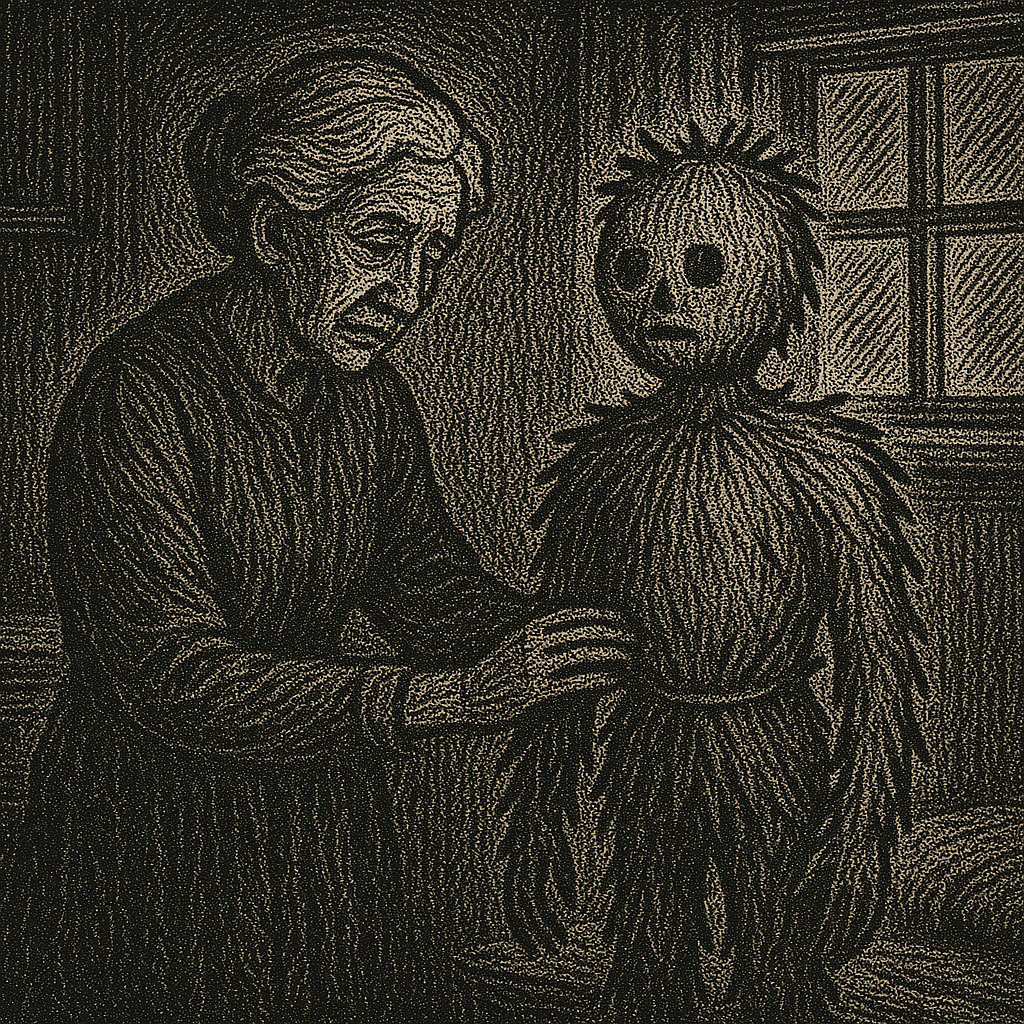
Upon the death of Eliza Webb, resident of Great Marsham and known associate of past FDG field alerts, villagers discovered a scarecrow-like effigy interred beneath the floorboards of her home. The figure was wrapped in a Great War military coat and bound with traditional fae threadwork. Most notably, it bore a bronze, unnamed Victory Medal marked with a jagged scratch in the shape of a stylised scarecrow’s head—matching a previously recovered artefact (see file: SV-MEDAL-1918-A).
During initial analysis, the figure partially reanimated and identified itself as Private Thomas Webb, believed lost in 1918. Its cognitive state was limited but suggestive of both trauma and identity retention.
A closure rite was performed using binding grain, inherited tokens, and chant reconstructions from Field Operative Thorne’s grimoire sources. The effigy returned to dormancy and was resealed beneath the property under containment glyphs.
Within 24 hours, a human male, approx. 65 years of age, was recovered from a nearby field—believed to be the original Thomas Webb, returned from Faylinn via unknown reversal mechanism.
HISTORICAL CONTEXT: SCARECROW EXCHANGE
This incident confirms longstanding oral reports of the Scarecrow Exchange—a wartime pact wherein fae proxies (straw effigies) were sent in place of human conscripts, with real individuals hidden in Faylinn for the duration of the war.
Terms of the pact:
If the scarecrow survived, the human might be returned.
If the scarecrow perished, the human would be bound permanently within Faylinn.
In this case, Webb’s scarecrow survived—though corrupted, confused, and decaying.
This is the second confirmed field discovery of a scarecrow-soldier bearing the unique unmarked Victory medal. The first (1923) was found propped against a tree and later archived after immolation.
MEDAL DETAILS
Name: Victory Medal (Unregistered Variant B)
Material: Bronze (enhanced through unknown enchantment)
Condition: Corroded, unissued, scratch resembles scarecrow’s silhouette
Effect on Handling: Subjective hallucinations consistent with WWI trench trauma, disassociation, time-displacement vertigo
Status: Archived in Section 2, Shelf 11, adjacent to SV-MEDAL-1918-A
Note: Second known example. Thread holes in uniform confirm it was stitched to body, not worn.
RETURNED SUBJECT: THOMAS WEBB
Biological Age: Approx. 65
Apparent Age: 45–50 (stasis degradation)
Mental Status: Disoriented, traumatised, coherent during intervals
Statements Recorded: 8 sessions
Notable Intelligence:
Descriptions of Faylinn war-scape: endless fields, marching circles, sensory loops
Mentions of pale men in red sashes, King in Barley, and Gatekeeper in the Orchard
Diagrams of gate structures, mimicry rituals, and possession glyphs
Deceased: 27 July 1961 (liver failure, presumed stress-related)
RECOMMENDED ACTIONS
Cross-reference Webb’s accounts with lost regiment sightings in Kentish folklore between 1918–1935
Begin systematic search for other Scarecrow Exchange recipients still in the mortal world or returned through cracks
Integrate scarecrow effigy monitoring with agricultural surveys in historically flagged villages
Upgrade Victory Medal status from Anomalous Artefact to Binding Token Class B
FIELD NOTES (Thorne, E.)
“We buried the straw, and the man came back.
He was too damaged to live.
But not too far gone to speak.
And not too lost to warn us.”
 Faylinn Defence Group