The Bloom That Felt Too Much
Filed under: Salt Hollows Flora | Bioluminescent Flora | Emotional Residue Organisms
Contributor: FDG Field Archivist No. 5
Last updated: May 2025
Overview
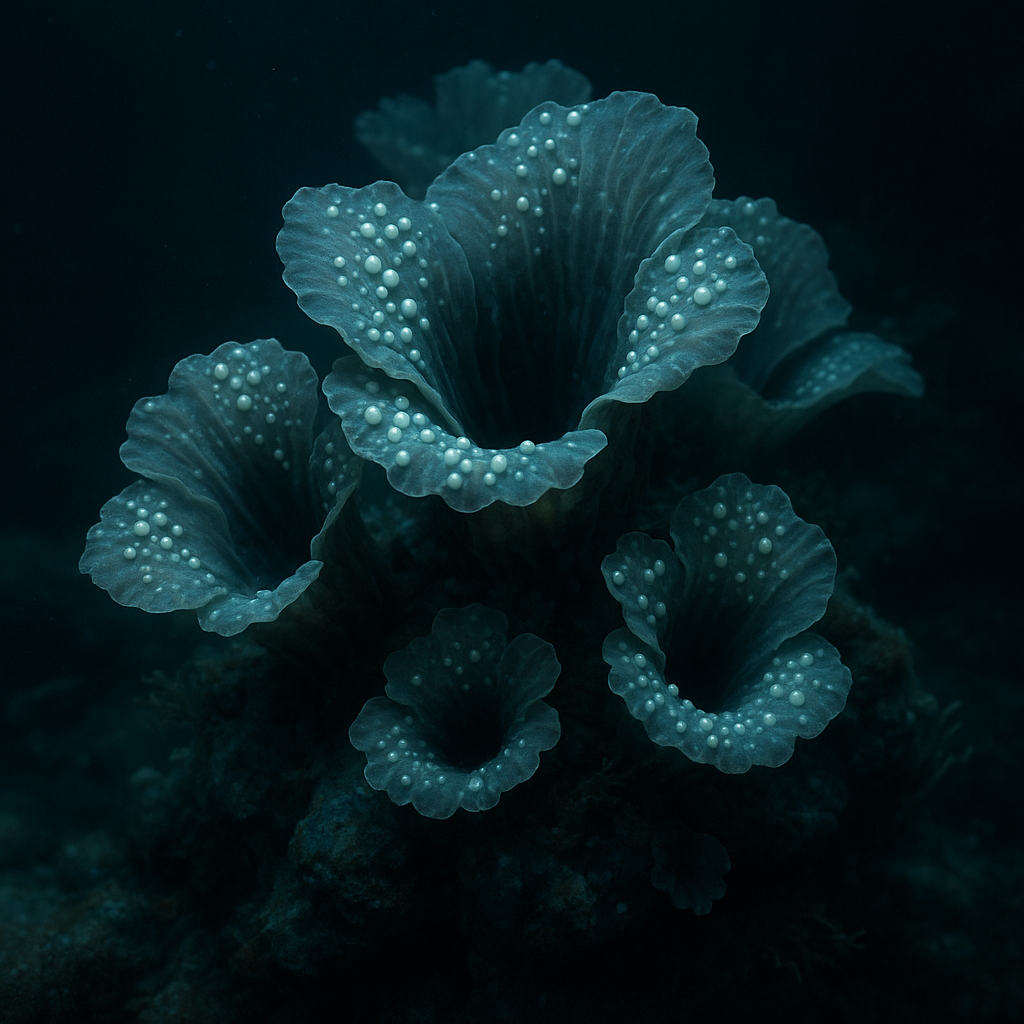
Drownbloom Coral is a rare, bioluminescent reef organism that thrives in depths saturated with emotional trauma. Unlike natural coral, it does not calcify over time—it blooms in sudden, violent clusters at the moment of psychic death.
Each “flower” glows in a different hue, corresponding not to temperature or salinity, but to the final emotion of the being who lost themselves at that exact spot.
They do not feed.
They do not think.
They remember what feeling killed you, and they burn it into colour.
Appearance
- Structure: Grows in low, tangled clusters resembling anemones or stunted roses
- Colour: Each bloom glows with an emotion-correlated hue (see chart below)
- Shape: Fleshy polyps that pulse faintly like breathing mouths
- Movement: Static, but fronds contract when approached by someone feeling the same emotion as the one that birthed the coral
- Environment: Grows only at sites of identity death—trauma that permanently alters or erases the self
Emotion–Colour Correlation Chart
| Emotion | Bloom Colour |
|---|---|
| Despair | Deep violet-black |
| Joy (lost) | Pale gold |
| Betrayal | Sickly green |
| Longing | Blue with silver edges |
| Fear (accepted) | Ice white |
| Regret | Red fading to rust |
| Numbness / Surrender | Grey-pink, flickering |
| Rage without outlet | Pulsing crimson |
Behaviour and Abilities
Emotional Residue Playback
- When approached, the coral may emit pulses of the emotion that birthed it, triggering:
- Sudden sobbing, laughter, panic, or dissociation
- Emotional memory recall from the subject’s past
- Reactions inconsistent with current mental state
- Some blooms “choose” a nearby person to imprint on, causing them to dream the life of the person whose emotion birthed the coral
Sympathetic Triggering
- Subjects experiencing strong emotion near matching blooms may cause:
- New coral buds to form
- Surges in bioluminescence
- Playback of the final thought or sentence of the person who “planted” it
Delayed Bloom Response
- The coral does not bloom immediately after death.
- It activates only when someone feels what the dead felt, even decades later.
- Thus, it may remain dormant until “reawakened” by parallel grief.
Folklore and Signs
The Drowned Garden
Legends speak of a diver who died by drowning in peaceful surrender—his bloom still glows soft grey-pink, and those who visit report a desire to “lie down and forget their names.” This site is now quarantined.
The Coral Choir
In trench myths, it is said that if many blooms of different colours pulse at once, the reef is trying to remember someone, or call them home. Operatives call this a “soulstorm.”
Lovers Who Lost Each Other Twice
A fae love story describes two people whose blooms grew side by side: one blue (longing), one green (betrayal). The blooms eventually entangled, pulsing together—after which, no one could distinguish which belonged to whom.
Effect on Earth and Human Minds
Mild Exposure
- Temporary emotion surges
- Weeping or laughing without cause
- Vivid dreams of unfamiliar deaths
- A compulsion to return to the coral site
Prolonged Exposure
- Emotional memory overwrite (foreign emotions replacing your own)
- False grief or rage toward living people who “feel familiar”
- Echo hallucinations (hearing or seeing the moment the emotion was born)
- Risk of emotional fragmentation—blending your sense of self with the dead
Summary for Field Operatives
| Trait | Detail |
|---|---|
| Threat Level | Passive. High emotional and psychic instability hazard. |
| Signs of Presence | Unnatural light in pitch-dark water. Sudden emotional spikes. Colours that feel “felt.” |
| Containment Risk | None; cannot be moved. Cutting coral causes feedback effect—harvester experiences birthing emotion at full strength. |
| Engagement Advice | Approach only with emotion-suppressing measures in place. Avoid interaction during times of personal turmoil. Never dive alone. Do not touch matching colour blooms without clearance. If you begin to feel sorrow that isn’t yours—surface immediately and undergo emotional grounding. |
“I touched the golden one. Just once.
And for ten minutes I remembered a joy so perfect it nearly stopped my heart.
I remembered a child I’ve never had—her face, her laugh. I still miss her.
I miss her like she died. But I’ve never been a father.”
—Dive Report 191-F, FDG Operative R. Harris, Bloom Cluster 8A

 Faylinn Defence Group