The Singing Fronds of Regret
Filed under: Salt Hollows Flora | Psychic Flora | Emotional Lures
Contributor: FDG Field Archivist No. 5
Last updated: May 2025
Overview
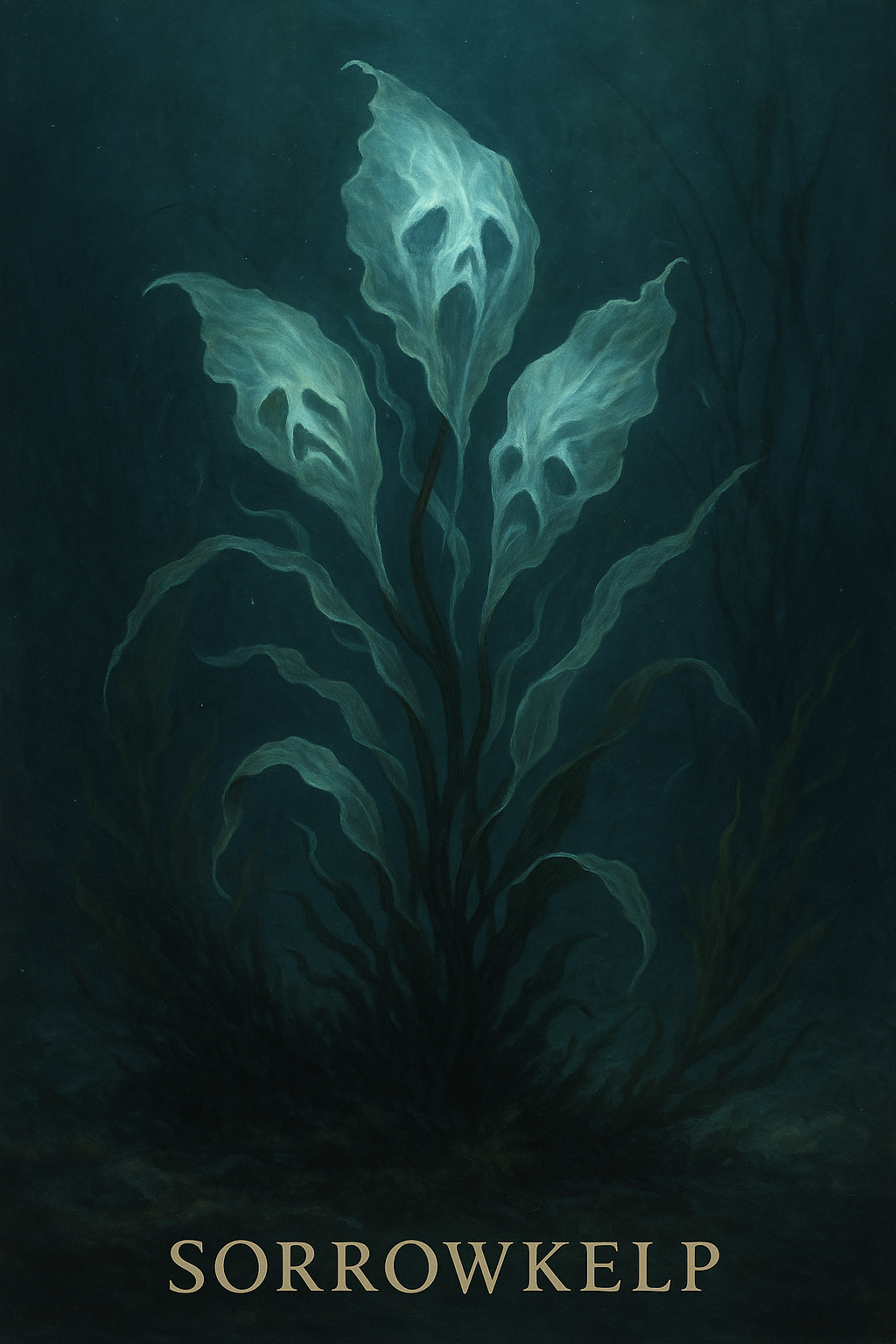
Sorrowkelp is a translucent, drifting marine plant species that grows in isolated trench pockets near grave-fissures and memory reefs. Its fronds emit a low, keening hum in response to nearby movement—though only the grieving can hear it.
These harmonics are not sound but memory-resonant pressure signals, often heard by subjects as lullabies, funeral chants, or the last song heard before a loss.
The kelp does not feed.
It does not speak.
But it will wrap around you gently until you forget why you were crying.
Appearance
- Length: 8–12 feet per frond
- Colour: Transparent with streaks of rust-red or bone-white running along the veins
- Structure: Flexible, lace-like kelp. Faint runes appear when exposed to grief-charged waters
- Glow: Emits faint phosphorescence when “heard”
- Motion: Uncanny stillness—moves only in reaction to mourners or forgotten names spoken aloud
Behaviour and Abilities
Emotion-Responsive Song Emission
- Sorrowkelp produces harmonic vibrations when:
- A grieving person is nearby
- A name is spoken that no longer belongs to anyone alive
- Forgotten lullabies or hymns are hummed near the reef
- Listeners often describe the “songs” as:
- Their mother’s voice from behind a door
- A melody from a childhood toy
- The sound of someone crying underwater
Psychic Anaesthesia Effect
- Prolonged exposure to the kelp’s hum:
- Induces calm
- Suppresses recent grief memories
- Causes temporal confusion (“I know I lost someone, but I don’t remember who.”)
- Overexposure may lead to emotional void states—blank affect, dreamlike passivity, inability to feel connection
Coiling Embrace
- The plant’s fronds wrap around divers or mourners with gentle undulation. Most victims report feeling comforted, though several never resurface.
- Operatives report a sensation of being “held by someone you once loved but can no longer name.”
Folklore and Signs
The Kelp That Cradles
A Salt Hollow widow’s tale tells of a sailor who dove to say goodbye to his drowned child. He was found days later, smiling, wrapped in Sorrowkelp. He had drowned, but without pain—his body still softly humming the lullaby.
Tide-Songs
In certain trench-faiths, the kelp’s sound is considered sacred music—some priests dive into it during rites of mourning, never to return. It is said they become part of the kelp, singing forever.
The Silence Before the Cry
Field agents report that when Sorrowkelp is active, the ocean goes eerily still before the hum begins. Dolphins and other sea life flee. Sound equipment often fails or records only static—until a name is whispered back.
Effect on Earth and Human Minds
Mild Exposure
- Calmness
- Dreamlike recall of lost people
- Temporary inability to feel grief fully
- Humming in the ears when underwater
Prolonged Exposure
- Memory suppression of bereavement
- Emotional flattening
- Sleepwalking toward bodies of water
- In extreme cases: identity disassociation triggered by loss erasure
Summary for Field Operatives
| Trait | Detail |
|---|---|
| Threat Level | Passive. Moderate to high emotional and cognitive hazard. |
| Signs of Presence | Unexplained calm. Humming or singing with no source. Dreams of lullabies or cradle rocking. Water standing unnaturally still. |
| Containment Risk | Moderate. Kelp can regrow from fragments. Cannot survive outside fae water for more than 24 hours. |
| Engagement Advice | Approach only if emotionally grounded. Do not speak the names of the dead while within 10 metres. Avoid physical contact with fronds—especially after recent loss. Wear auditory-dampening hoods if grieving. If caught in kelp, recite a name you still remember with love. That may release you. |
“I didn’t cry. That’s what scared me. I saw the memory, I saw the face—I knew it had once mattered.
But it felt like watching someone else mourn.
Like the grief was in a tank I’d already walked away from.”
—FDG Submersible Report 44-B, Operative M. Stone
 Faylinn Defence Group