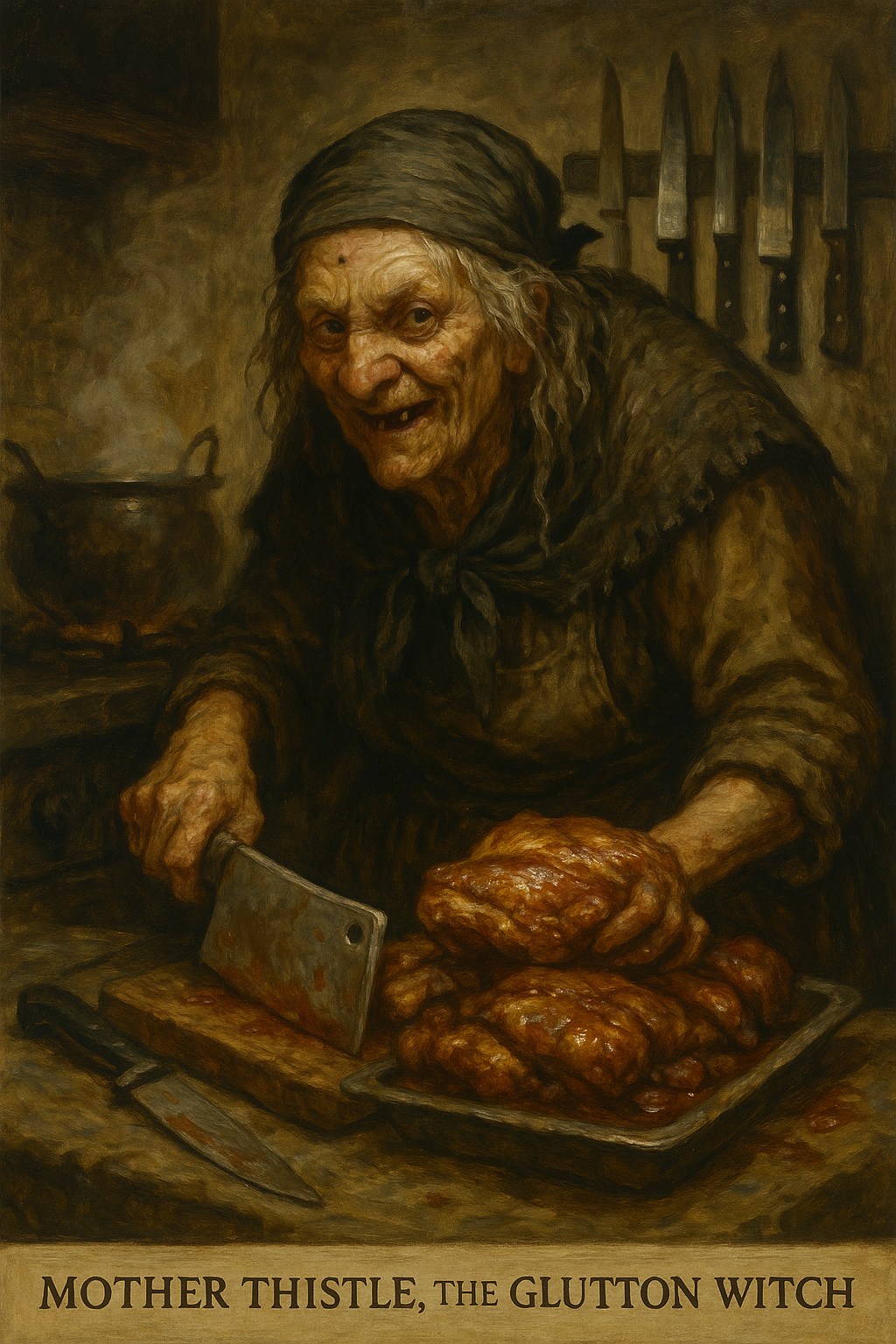
“Every country has its rot. I just keep mine well-seasoned.”
There is a place in the Pale Country where the light bends wrong.
Tucked into a fold of mirrored grassland—a smooth hollow in a sunlit bank where shadows pool like oil—lurks a kitchen that should not exist. It is clean, yes. Gleaming surfaces. Racks of glittering knives arranged with obsessive care. Cabinets full of fragrant herbs. But it stinks of marrow and memory.
This is the lair of Mother Thistle, the Glutton Witch.
Once a noble of a darker court—perhaps Mirecourt, perhaps deeper still—Mother Thistle was exiled for violating the Pale Country’s prime law: beauty without appetite. She brought taste, texture, mess into a place ruled by restraint. She laughed too loud. Ate with her hands. Fed the Silent Choir stew. It was… unseemly.
She was not executed. She was allowed to hide.
Now, she is a secret tolerated only because no one dares speak her name in court.
A sagging, soot-smeared crone with iron fingernails and a tongue too long for her mouth, Mother Thistle lurks in her glade-kitchen, preparing meals no one asked for. Her pots stir themselves. Her oven hums lullabies. She carves meat that shouldn’t exist, whistling snatches of human nursery rhymes. Her favorite ingredient is “fat little liars.”
But there’s a catch: she cannot feed on the fae. Their beauty chokes her. She requires mortals—flesh full of guilt, fear, and unmet hunger. And so, she crosses into the human world, disguised as a kindly tea lady, a lost grandmother, or a cake-baking recluse in rural England. She draws in the lonely, the greedy, the unloved. Children are her favorite. Adults, if desperate.
The Thorne Institute has several open case files tied to her—incidents of vanished children near fairgrounds or village fêtes, all involving women with iron cooking pots and too many teeth.
Mother Thistle’s magic is stomach-based. She can smell secrets. Digest names. Burp up memories. She sometimes trades recipes in exchange for stories—especially traumatic ones, which she ferments into syrups.
Despite her horror, there is something tragic about her. She once tried to host a “banquet” in the Pale Courts. No one came. Only Orrin, the child-singer, lingered near her door. He did not eat. But he left a ribbon.
She keeps it pinned to her apron.
If she ever does find a way to corrupt a fae meal or make the Hollow Queen hunger, the balance of the Pale Country may shatter.
Until then, she waits in her hollow.
Knife gleaming. Pot simmering. Smile too wide.
 Faylinn Defence Group