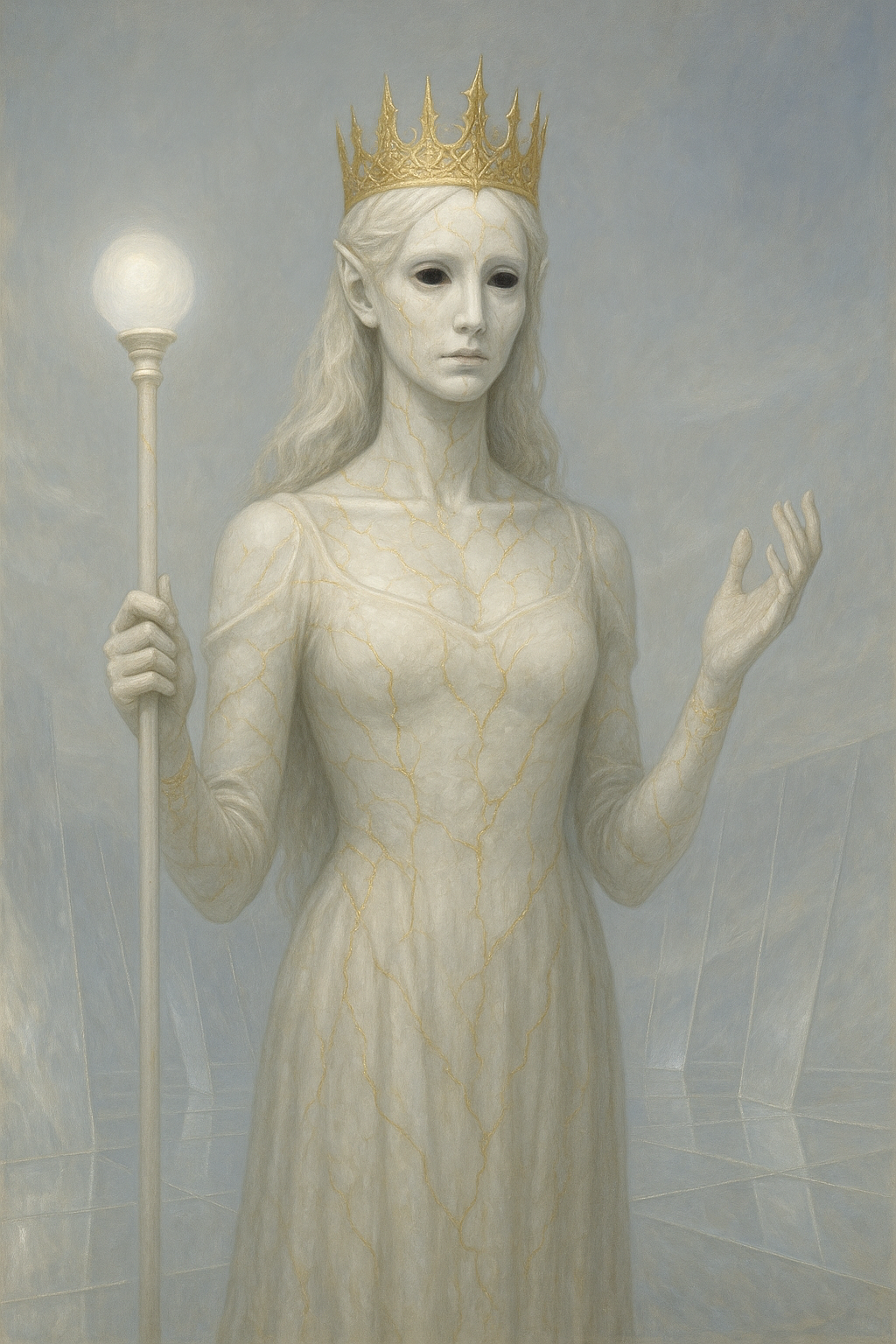
Ruler of the Pale Courts
“She has no shadow, and so she borrows yours.”
There is a silence in the Pale Courts that predates sound, and at the heart of that silence sits Queen Elidore the Hollow. Sculpted from alabaster and threaded with veins of living gold, she moves with the gravity of a celestial body—slow, flawless, inescapable. Her hollow body is a resonating chamber for lost feeling. She remembers what she has never lived by drinking the dreams of mortals—specifically those tinged with heartbreak, longing, or love unfulfilled.
Elidore is not cruel, but neither is she kind. Like a perfectly carved statue, her beauty invites awe, not warmth. Those who look into her eyes see themselves reflected without emotion. She wears a crown of woven glass that hums softly in response to ambient desire, and she communicates through ritual, gesture, and orchestrated tableaux rather than speech.
Her court is governed by ritualized silence: every movement, every breath follows a coded performance. The queen’s displeasure manifests in flickers of light and twisted reflections. She does not kill—she erases, folding the offender back into the structure of the Pale Country, their personality woven into wind chimes or knight’s armor.
Legends say Queen Elidore once loved a mortal. Others claim she was created to hold all the beauty of the world and none of its pain. Whether a cursed oracle, an exiled star, or a god-fragment locked in an aesthetic prison, she is timeless. Even among the fae, she is feared. Not for her power—but for her emptiness. Her realm bends around her desire to remember what it meant to feel, though she cannot weep, bleed, or break.
Visitors—rare and fragile—sometimes find her watching human dreams in pools of mirrored water. If she sees something beautiful, she may try to replicate it in her realm, leading to spontaneous ballets, frozen dinners, or operatic duels that loop forever without meaning. She is not mocking us—only imitating the shape of feeling. It is the closest she can come to love.
 Faylinn Defence Group