The fog takes
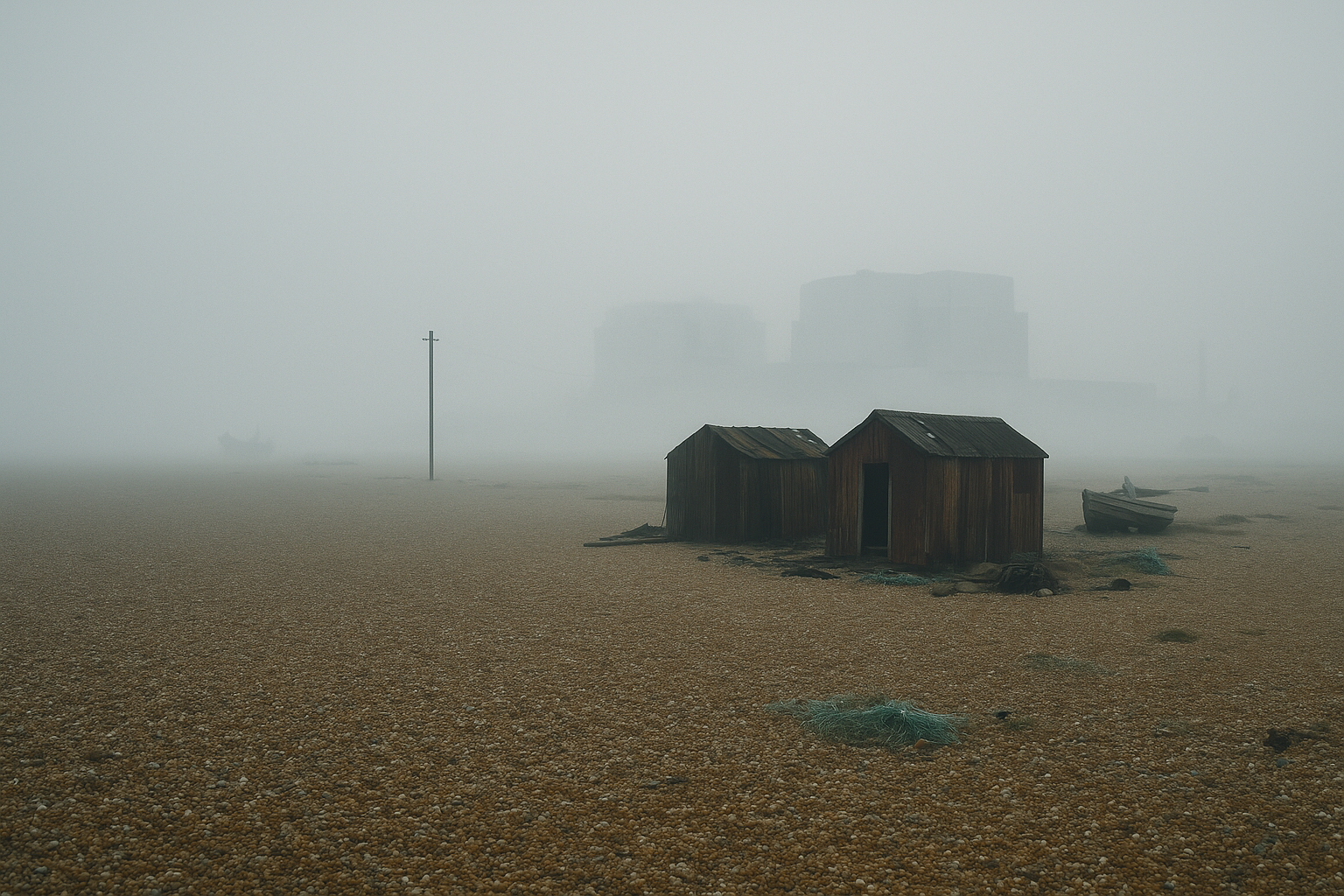
Dungeness — November 1952
The world smelled of smoke and brine.
Misha’s boots crunched across the shingle. The power station loomed to the east, still under construction—a brutalist promise of atomic progress, ringed by wire and warning signs. To the west, the marsh whispered. Fog rose off it like breath from the Earth itself.
He checked his watch again. Twenty minutes late.
His contact was meant to meet him here—“Mallory,” an MI6 man he’d never seen, only heard of in coded messages ferried by couriers across the continent. Misha had risked everything: burned a dozen identities, bribed his way through Berlin, slipped past watchers in Vienna. And now—silence.
He adjusted the collar of his coat. His Soviet diplomatic credentials were tucked inside a false lining. He was supposed to become someone new here. But instead he stood alone on a haunted shore.
And then the fog moved.
Not drifted—moved.
It rolled in like theatre curtains drawing shut. The horizon vanished. The wind dropped. Every sound—the crunch of shingle, the hum of distant equipment—fell away.
And out of the mist stepped a woman.
She was barefoot. That was the first thing he noticed. Bare feet on cold stones, pale toes curling slightly with each step, as if tasting the earth. Her dress was simple—linen, off-white, fluttering though there was no wind. Her hair hung wet down her back.
He couldn’t see her face. Not really. Every time he tried, the fog thickened behind her like a veil.
“Are you lost?” she asked, in flawless Russian.
Misha swallowed. “I’m waiting for someone.”
“They’re not coming,” she said gently. “But you came so far. You must be tired.”
He stared at her, trying to reconcile her presence with reason, with the instructions he’d memorised. The dead drop. The signal phrase. The escape route.
None of them covered her.
“You don’t belong here,” she said. “Let me take you somewhere quiet.”
“I don’t know you.”
“But I know you.” She tilted her head. “You remember the bread shop on Bolshaya Ordynka. The one with the cinnamon rolls? And your mother’s red gloves. You hated the scratchy wool.”
He froze.
“Come,” she said, holding out a hand. “You’ve wandered too far.”
He didn’t remember taking it.
1974 — Military Records Wing, Kent Archive Branch
Elena Quinn flipped through the brittle files with gloved fingers, eyes scanning carbon copies and faded stamps. MI6 hadn’t wanted her here, but the Institute still had a few strings to pull, and this operation—Project Cold Circle—was decades old and long disavowed.
She found it in a dusty manila folder marked with a red wax seal that had half-flaked away: OPERATION COLD CIRCLE: ASSET “MALLORY” — STATUS: MISSING, 16 NOV 1952
There were only two pages. The first detailed a planned exfiltration at Dungeness, involving a “high-value defector of scientific importance” codenamed Comet. The second was a post-mission summary, terse and resigned:
“No contact made. Site compromised by unexplainable atmospheric interference. Fog too dense for aerial surveillance. Radio contact failed. Mallory presumed lost.”
Elena frowned. The margins of the report were oddly warped, like something had spilled—not liquid, but pressure, as if the paper had been exposed to more than air.
She folded the pages and slid them into her satchel.
Locals spoke of her, too. Elena had already interviewed two retired lighthouse keepers and a half-mad vicar who claimed “the fog’s been wrong ever since the war.”
Wrong fog.
The same phrase had cropped up in her father’s journals.
Dungeness Beach, same day
The wind had died entirely. Only the crunch of Elena’s boots marked the silence.
The tide was out, revealing endless grey shingle littered with rusted fishhooks, sea-glass, and gull-picked crab shells. The skeletal remains of old boats leaned sideways like forgotten graves. Up the coast, the old sound mirrors rose from the stones like the backs of half-buried giants.
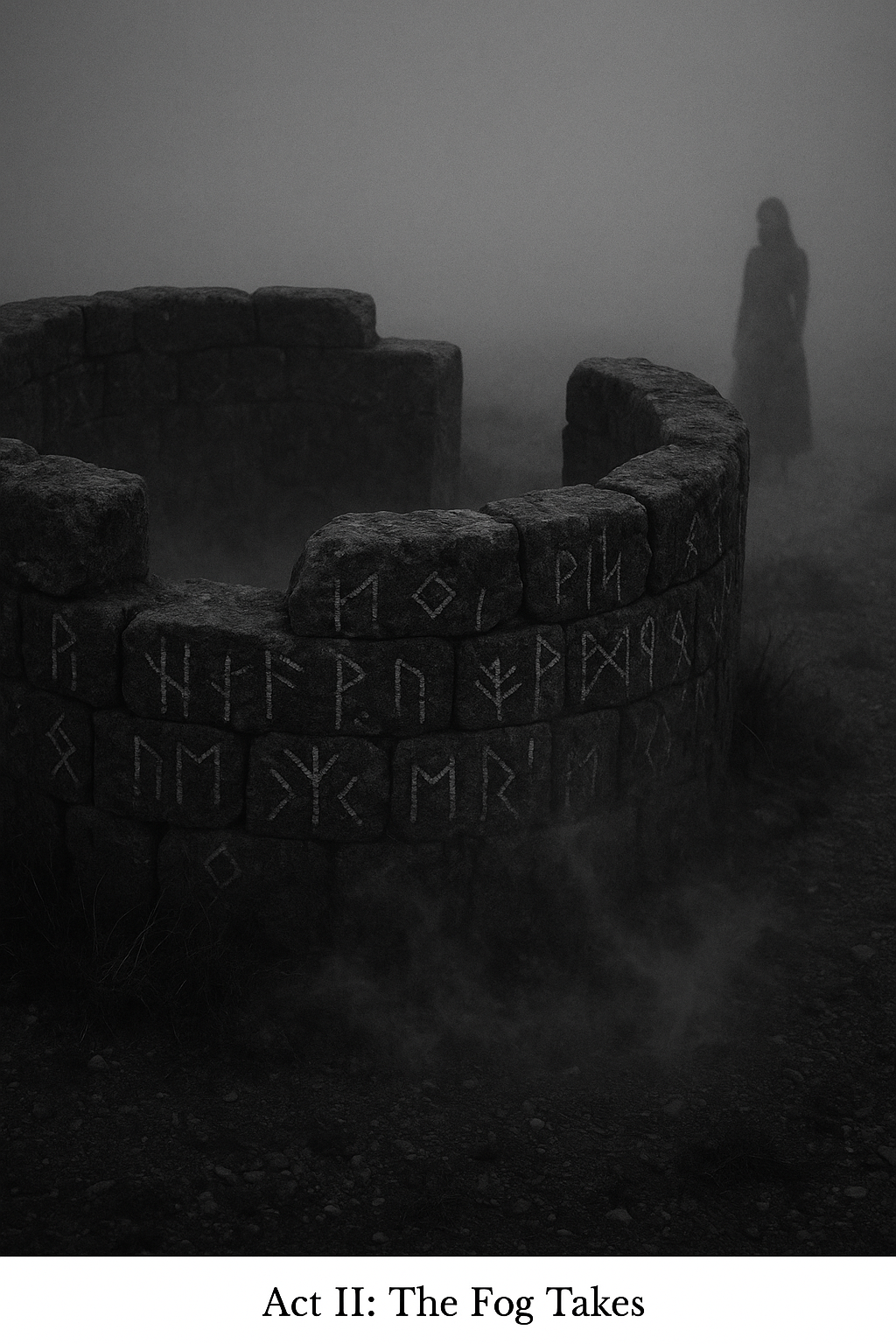
She stopped at what might have once been a military outpost—low stone walls, blackened timber beams, all half-sunk and furred with salt. Carved into one of the foundation stones were symbols—not English.
She knelt.
The shapes were familiar—protection glyphs. But old. Older than Christianity. Older than Empire. She traced one with a gloved finger, and the air seemed to tighten.
Then she heard it.
Faint, distant—a woman singing.
Not in a language Elena knew. Not Slavic. Not even human, maybe. But it was beautiful and slow, like something sung to keep the world asleep.
She stood quickly, hand on the revolver beneath her coat. But there was nothing there.
Only the fog.
Back at the Hospital
Misha sat cross-legged on his bed, palms open, eyes closed. He looked thinner than before. Paler. As if the fog had followed him indoors.
Elena pulled the chair closer. “Tell me more about her.”
He opened his eyes. “She was always there. I could never see her clearly. The place—it wasn’t a house. It was more like the idea of a house. Walls that weren’t walls. A hearth that never gave off heat. Fog outside every window, though I couldn’t find the doors.”
He shuddered.
“Time didn’t move. It… drifted. Sometimes she’d ask me questions about my past. Sometimes she’d sing. She’d remember things I hadn’t told her. The smell of ink. My grandfather’s boots. But I couldn’t remember my own face anymore.”
Elena felt her stomach turn. “Did you try to leave?”
“Many times. I’d walk away, thinking I’d broken free, but I’d always come back. The path looped, or maybe the place did.”
He looked at her sharply.
“She likes minds that wander. People who are alone. That’s who she chooses.”
He reached into the pocket of his coat. Not the hospital gown—the coat he’d arrived in, which Elena had retrieved from secure storage. He pulled out a slip of paper. A name was written on it in shaky Cyrillic.
“Elena Quinn,” he said softly. “She told me about you.”
Elena’s Apartment, 3 a.m.
She woke to fog pressing against the glass.
In the dream, she’d been walking across a grey field, and Clara—her sister—had been ahead, laughing, always just out of reach.
But she didn’t have a sister.
Did she?
She got up and walked to her desk. Something compelled her to open the bottom drawer.
There, beneath her father’s field notebooks and her own journal, was a photograph.
Two girls, side by side in matching coats. One was clearly Elena at age nine.
The other was Clara.
She stared at the photo until the dawn light dulled the edges.
She wasn’t just investigating this.
She was being drawn in.
 Faylinn Defence Group