The return
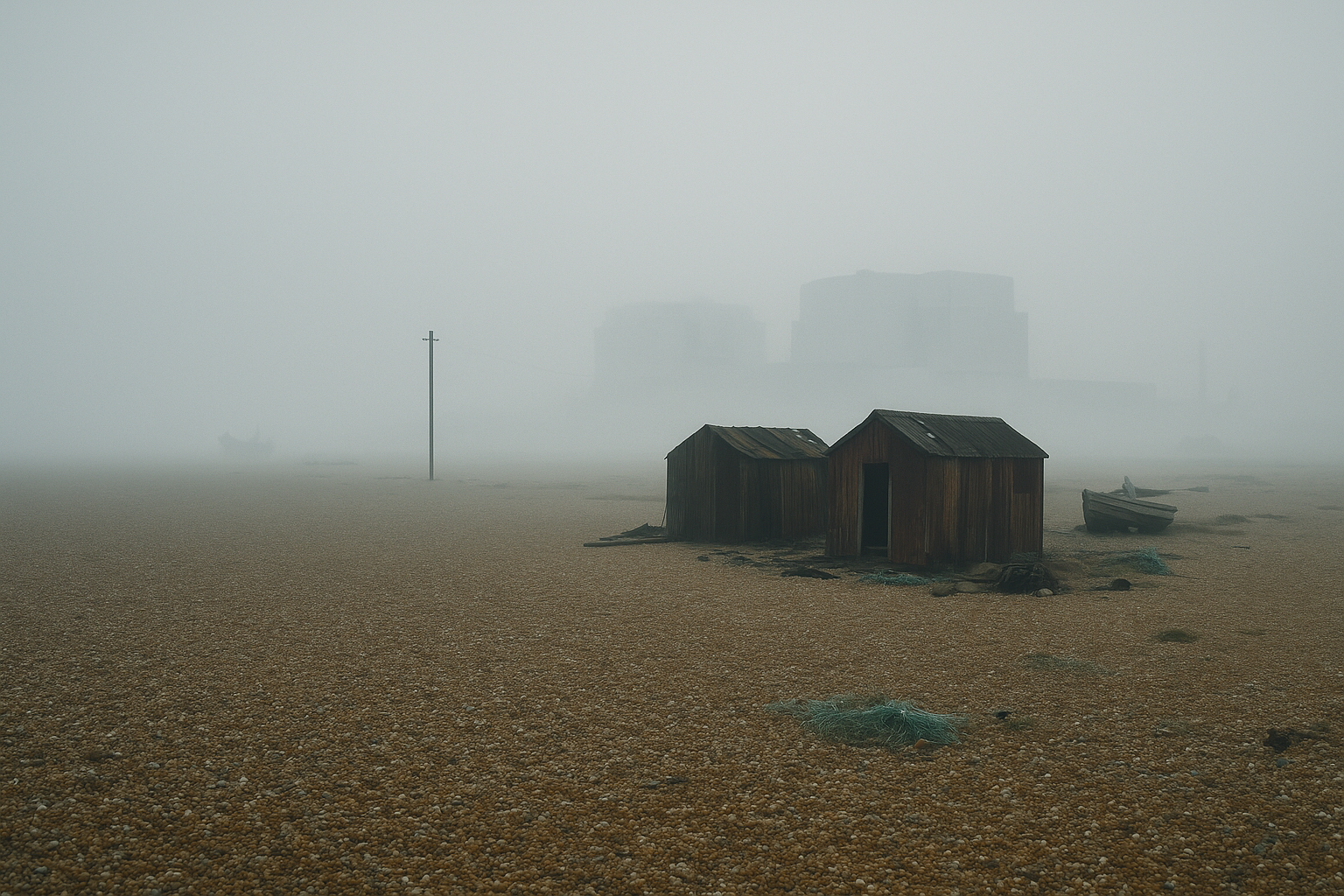
Dungeness, Kent – November 1974
The fog was unnatural.
Not just thick—dense, pressing, intentional. It moved against the wind and refused to lift even as the morning wore on. Crows refused to call. The sea, a quarter mile away, made no sound. The gravel road through Dungeness, lined with salt-crusted fencing and half-collapsed beach huts, had no business carrying traffic at this hour. And yet, PC Naylor’s Ford Cortina groaned its way through the mist like a ghost looking for a home.
The headlights barely reached ten feet ahead. The radio sputtered between crackles of static and Glen Campbell, drifting in and out like a fading memory.
Then something stepped into the road.
The brakes squealed.
Naylor swore, the car jolted, and the world snapped into silence again.
He’d missed the man by inches.
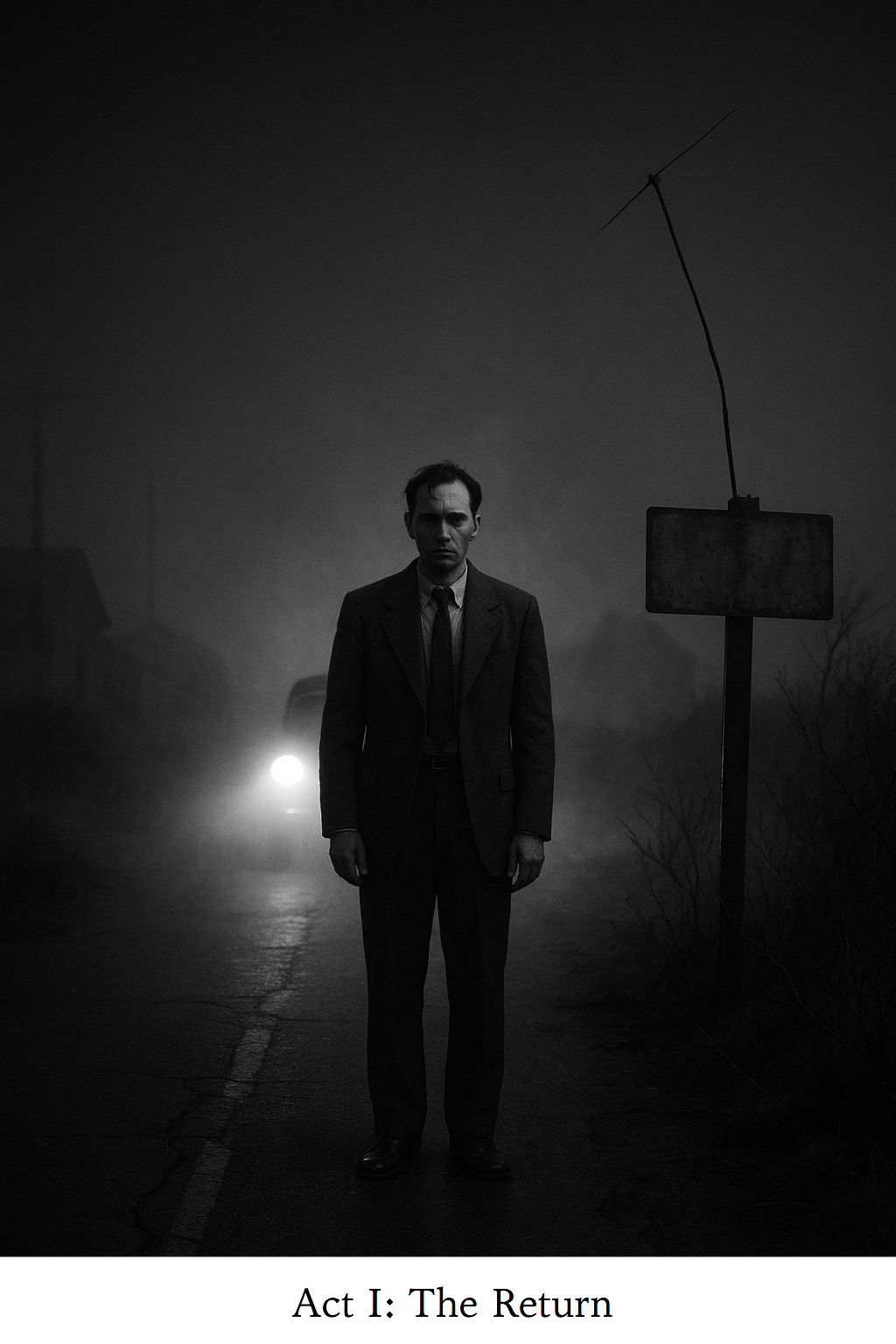
The figure stood motionless in the middle of the road, backlit by the weak amber of the headlights. He wore a brown wool overcoat with the stiff structure of post-war tailoring—collar turned up, cuffs pristine, shoes shined like a soldier on parade. No hat. No gloves. And—most unnerving of all—not a hint of moisture on him, though the air was wet enough to bead on glass.
Naylor got out of the car slowly. “Sir? Are you alright? You shouldn’t be out here, not in this fog.”
The man turned. His face was pale and unlined, hair dark and neatly combed, as though he had just stepped out of a London office in 1952. Which, in a way, he had.
“I—” The man blinked. “Where is this?”
“This is Kent, sir. Dungeness.” Naylor glanced around. “There’s nothing else for miles.”
“Dungeness,” the man repeated, like a prayer or a curse. He looked down at his hands, flexed his fingers as if checking whether they still obeyed him. “And the year?”
Naylor hesitated. “It’s 1974.”
The stranger froze. His breath caught—and then resumed, slowly, as though this was simply another puzzle to solve.
He reached into his coat and retrieved a slim leather wallet.
Inside was a folded document: brittle paper, typed in Russian, bearing a hammer-and-sickle seal and a photograph that matched the man exactly.
Mikhail Alexandrovich Levin, b. 1917. Diplomatic Transit Authorization – Issued Moscow, October 1952.
Ashford Military Hospital – 3 days later…
Major Arthur Quinn had seen a lot in his twelve years with the Thorne Institute—vanishing naval vessels, haunted airbases, ley-line resonance disturbances. But the man sitting behind the reinforced glass of Interview Room 3 unnerved him more than any howling spirit or scorched summoning circle.
Because Mikhail Levin should have been fifty-seven years old, not thirty-five.
And yet there he sat—back straight, expression blank, still dressed in his outdated clothes. A boiled-wool suit from another era. His tie was a little too narrow. His shoes had metal eyelets and a slight Cuban heel. He looked like a propaganda poster had come to life and simply wandered into the present.
“Thank you for speaking with me again, Mr. Levin,” Quinn said, settling into the chair across from him.
Levin inclined his head slightly. “Of course. Though I am still unsure what… this is.” He gestured vaguely to the room, the mirrored glass, the tape recorder. “You are not MI6.”
“No. We’re a specialist organisation. We look into unusual… phenomena. Your case was flagged.”
Levin gave a short laugh that didn’t reach his eyes. “Yes. I suppose it would be.”
Quinn studied him for a long moment before speaking. “Mr. Levin, do you remember what happened the night you disappeared?”
Levin was silent for a while. Then: “I was to meet a contact. British. I had agreed to defect. We arranged the rendezvous near the power station.” He looked down at his hands again, as if seeing them anew. “There was fog. I waited a long time. He never came.”
“And then?”
Levin’s voice dropped. “There was… a woman.”
Quinn sat forward.
“She came out of the fog. I could not see her face, not clearly. But her voice—it was familiar. Not the words. The tone. She asked me if I was lost.” Levin looked up, eyes haunted. “I was. I didn’t think I was until she said it.”
“What did she do?”
“She offered to take me somewhere safe. Somewhere quiet. I thought she was part of the operation. Or maybe I was drugged. I followed her.” His breath hitched. “After that… I don’t know how long I was there. The place had no walls. The fog was everywhere. And she—she was kind. But I was never allowed to leave.”
Quinn scribbled something down. The symptoms matched. Lost time. Memory dislocation. Mild electromagnetic interference. Fae boundary contamination was likely.
“She said I was ‘hers now,’” Levin whispered. “But she let me go. I think. I walked until I wasn’t walking anymore. And then… I was on the road.”
Quinn’s pencil paused. “You said she let you go. Did she say why?”
Levin blinked. “She turned away. She saw someone else.”
Thorne Institute Internal Memo
From: Major Arthur Quinn
To: Director Halvorsen
Subject: Category Theta Event – DungenessLevin is exhibiting classic signs of temporal displacement, fae-locus interaction, and secondary cognitive dissonance. Recommend immediate site investigation. Locals still whisper about “the Fog Lady.” Archive records show at least four disappearances in the area between 1947 and 1963.
Requesting permission to deploy Agent Elena Quinn for field analysis. Dungeness is already listed as a Watch Site (Red Level). Time window for containment may be narrowing.
End memo.
Elena Quinn stood at the edge of the shingle shore, her coat whipped by the wind that no one else seemed to feel.
The Dungeness Nuclear Power Station loomed behind her, a hulking skeleton against the mist—a relic of a future that never quite arrived. The old sound mirrors—concrete parabolas used to catch enemy aircraft noise in the ‘30s—stood cracked and birdless in the distance.
Everything here felt old and forgotten, as if time itself had grown tired and simply decided to stop.
She knelt by one of the standing stones half-buried in the pebbles. Chalky white symbols curled across its surface—protection glyphs, designed to keep something out. Or in.
Fog stirred against her boots.
She looked up—and saw a shadow moving through the mist.
Not a person.
Not quite.

 Faylinn Defence Group