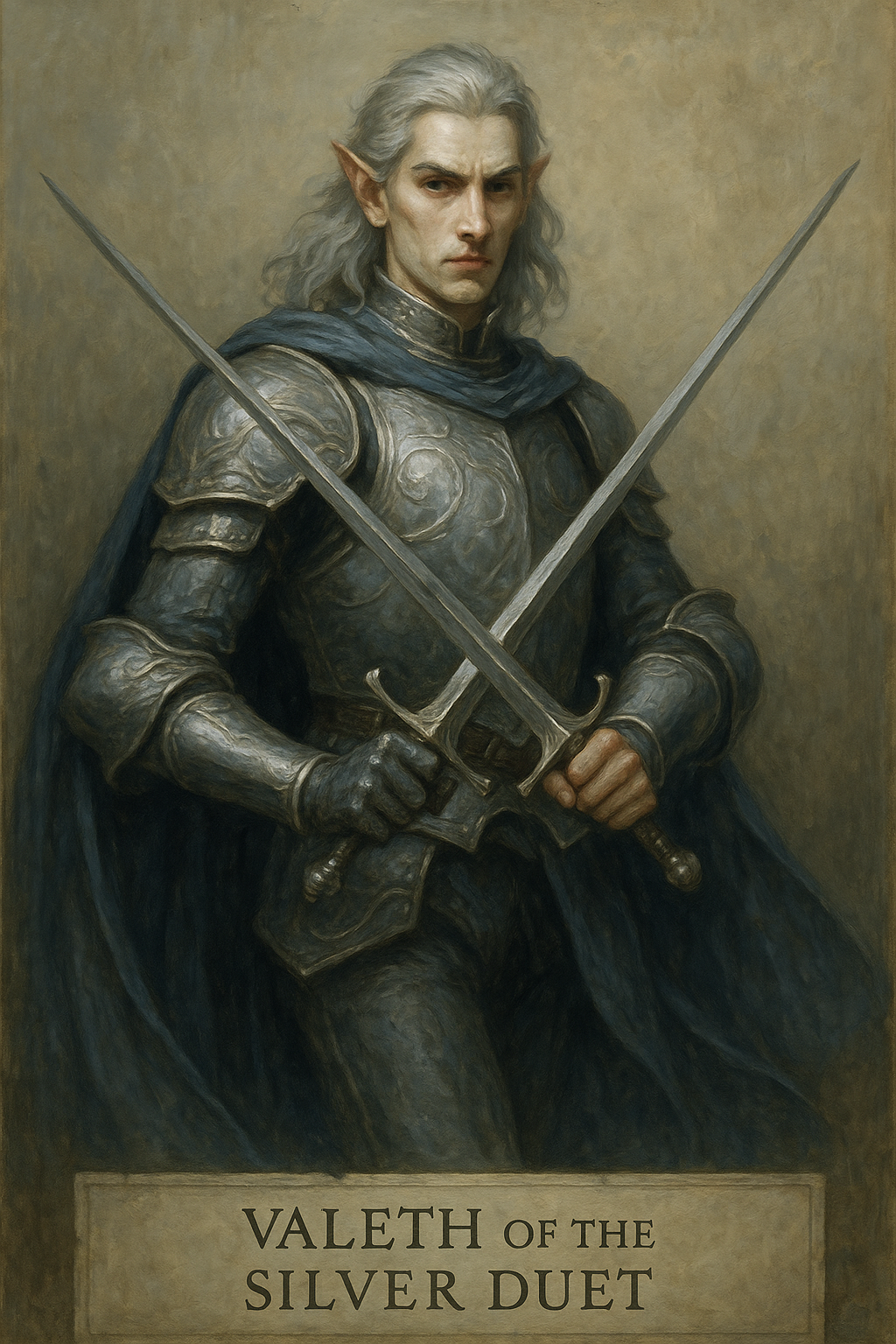
“To strike without flaw is mercy. To strike with feeling is treason.”
Valeth was not born, but composed. Forged from mirrored steel and ritualised grief, he is the most celebrated of the Pale Courts’ duelists—and its most tragic. Locked in an unending battle known only as The Silver Duet, he and his opponent reenact the same flawless combat each day, repeating the identical sequence of feints, glides, and mirrored strikes without fail.
But the other duelist is long gone.
No one remembers her name—only that once, long ago, she faltered. She laughed mid-duel. A laugh is not permitted in the Pale Courts. She vanished. The court rewound. The sequence reset. And now Valeth must fight alone.
Each morning, the music begins—soundless but present, like a vibration in the soul. Valeth steps into the mirrored dueling hall where light bends to form his opponent. A shadow formed of absence. Together, they dance-blade in perfect synchronicity, steel singing along invisible lines.
He is flawless. He must be. If he falters, the day restarts.
But beneath his polished armor—engraved with the ever-shifting reflections of nearby emotion—Valeth remembers. He recalls the moment his partner’s laughter rang out, bright and alive and utterly human. He recalls the Queen’s silence afterward. He recalls the cold reset. And he wonders, each day, whether this will be the one where he too disappears.
Valeth is revered by courtiers and feared by rivals. He is the embodiment of grace, pain, and submission to form. He has not spoken in centuries, though sometimes, as his blade arcs in a ghost-strike, witnesses claim to hear a whisper in the clash: “Forgive me.”
He wears no helm. His face is beautiful but blank—a surface onto which others project whatever they need: a hero, a traitor, a lost lover. His hair is silver-threaded with glass. His eyes reflect the last person to look into them.
Though bound to the Pale Courts, Valeth has appeared in certain human dreams—particularly those involving grief, guilt, or longing. In one Thorne Institute case file, a widower reported waking daily with identical cuts on his arms after dreaming of fencing with a silver-eyed knight. On the final night, the knight let him win. He awoke untouched, the grief gone, but so was his reflection.
Valeth’s tragedy is not in being trapped—but in knowing he’s trapped.
He does not seek escape. Only a partner who will stay.
Even if it means breaking the dance.
 Faylinn Defence Group