The Memory-Mice of the Deep
Filed under: Salt Hollows Fauna | Minor Faebeasts | Memory-Damaging Vermin
Contributor: FDG Field Archivist No. 5
Last updated: May 2025
Overview
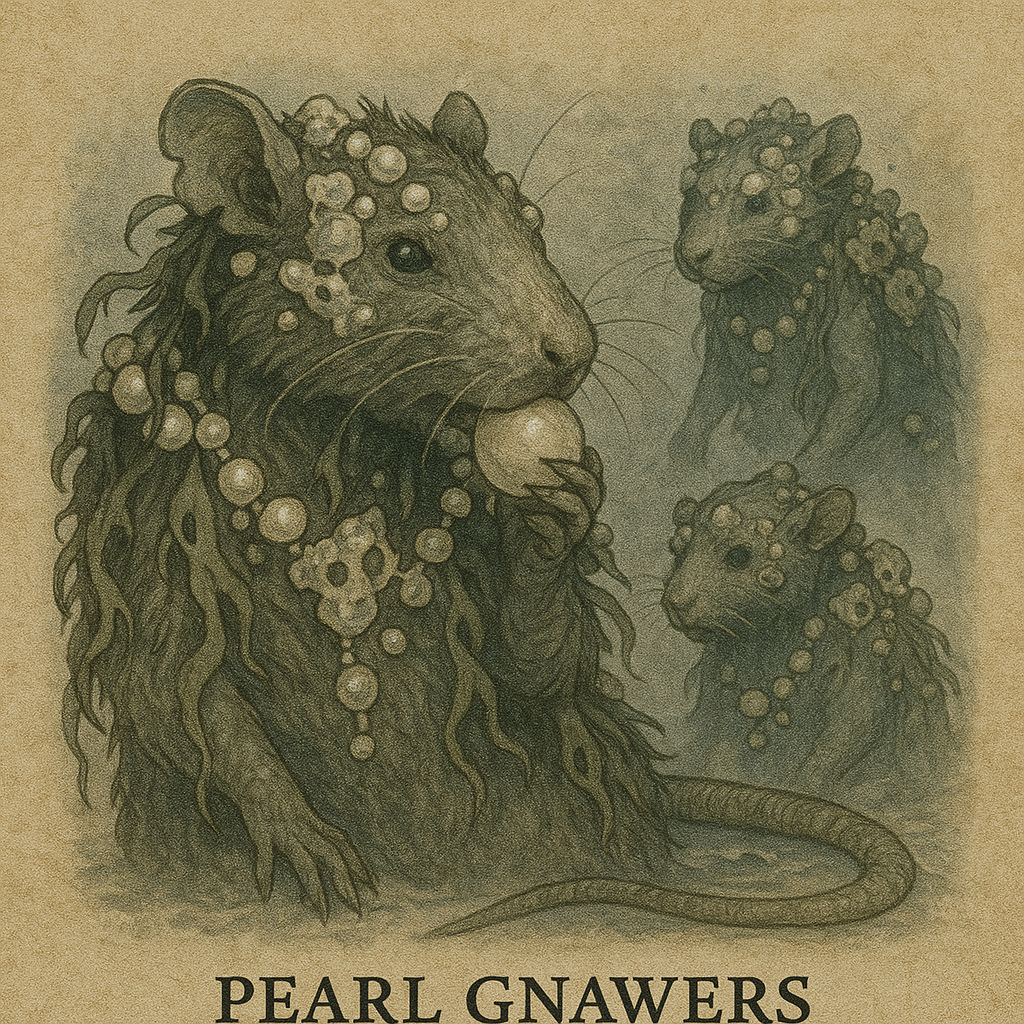
Pearlgnawers are rodent-sized, semi-sentient fae beasts that dwell in memory pearl beds deep within the Salt Hollows. These creatures do not feed on flesh or light—they consume memory, specifically by gnawing on the calcified emotional nodes known as pearl-thoughts, which cluster around dream-coral and grief vents.
The result is not destruction, but distortion. The gnawed pearls leave behind emotional husks—feelings with no known cause, grief without story, joy without event.
They are not pests in the traditional sense.
They are erasers with teeth.
Appearance
- Size: Comparable to a small rat
- Body: Grey, semi-translucent; internal organs faintly visible
- Limbs: Thin, jointless; feet produce no sound
- Teeth: Wide and flat, rimmed with nacre; adapted for grinding pearl matter
- Eyes: Milky white, lidless; seem unaware of light
- Tail: Ribbon-like and frayed, trails behind like a thought unraveling
Behaviour and Abilities
Pearl Consumption
- Pearlgnawers feed by burrowing into memory pearl clusters and chewing down to their emotional core.
- This process leaves the surface of the pearl intact but scrambled—when activated by dreamers or researchers, the memory plays back as:
- Reversed cause and effect
- Misassigned emotions (e.g., laughter at a funeral)
- Hybridized memories combining multiple sources
Memory Residue Contamination
- Operatives who handle gnawed pearls report:
- Sudden emotional bursts without identifiable origin
- Feelings of loss for people they’ve never met
- Distorted flashbacks with incorrect details (e.g., wrong age, face, outcome)
Scent-Based Navigation
- Pearlgnawers are drawn to memory-heavy individuals—those grieving, ruminating, or steeped in nostalgia.
- May emerge to “nuzzle” near the head or heart before vanishing—leaving the subject emotionally shaken or partially emptied.
Folklore and Signs
The Hollow Crib
Old tales describe Pearlgnawers crawling into a sleeping infant’s ear to chew on unformed future memories—stealing the child’s imagined life and leaving them listless. Survivors often grow up unambitious, gentle, and haunted by dreams of a life they were never offered.
Grief with No Story
In several fae-impacted coastal communities, a cultural illness known as “drift-ache” is attributed to Pearlgnawer contamination—sufferers burst into tears without knowing why, often while near the sea, and report a lifelong feeling of having forgotten something important.
The Clatter Underwater
Divers have described hearing a faint clicking or chewing sound from coral beds, despite no current. It is said that if you hear the gnawing and do not leave, you may forget your dive partner’s name—or your own.
Effect on Earth and Human Minds
Mild Exposure
- Emotional confusion
- Nostalgia for non-existent people or events
- Dreams in which familiar objects evoke unfamiliar feelings
Prolonged Exposure
- Memory fragmentation (especially autobiographical)
- Hallucinations of gnawed objects or creatures made of pearl
- Phantom mourning syndrome (weeping for “something you can’t remember losing”)
- Difficulty forming new memories related to love, grief, or personal growth
Summary for Field Operatives
| Trait | Detail |
|---|---|
| Threat Level | Low physical risk. High long-term emotional-cognitive disruption. |
| Signs of Presence | Faint chewing noises. Partially damaged memory pearls. Sudden emotional surges. Animals reacting to unseen presence. |
| Containment Risk | High. Pearlgnawers multiply quickly and nest within trench artefacts brought topside. Entire labs have had memory banks compromised. |
| Engagement Advice | Do not handle unfamiliar pearls with bare skin. Store pearl specimens in sealed iron-crystal containers. Monitor emotional stability closely post-exposure. If you begin to mourn something you cannot name—report immediately and initiate memory stabilization protocols. Do not let them nibble what makes you human. |
“It was like someone removed the spine from the memory. It still stood up. I still felt it.
But it didn’t move. It didn’t mean. It was just a shape of grief.
And now that grief is mine, but I don’t know whose it was.”
—Field Journal, FDG Archivist L. Kimura, Coral Shelf 9-C, Abandoned Pearl Garden

 Faylinn Defence Group