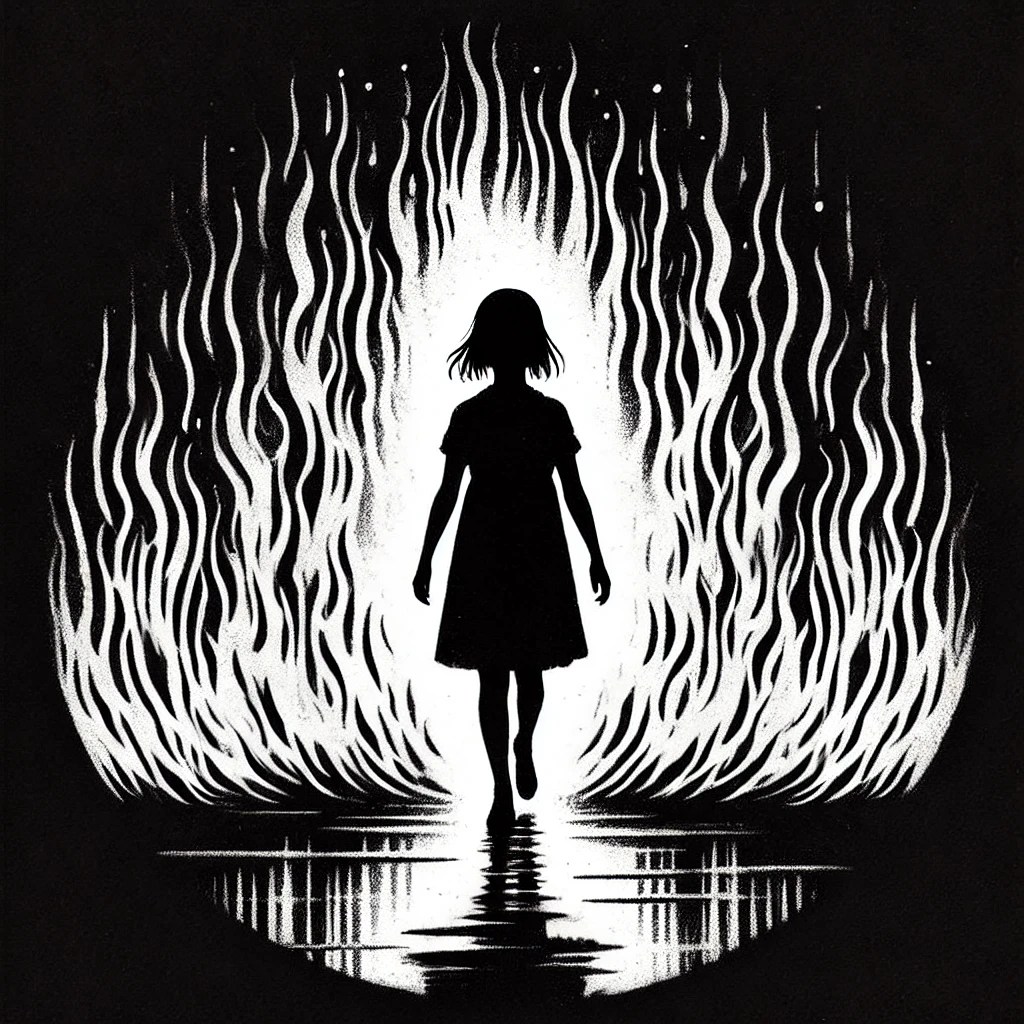
Ruth stood at the kitchen window, staring out across the bare wheat fields in the distance. It was always the same this time of year. She found herself lost in the past, trying once again to make sense of what had happened.
At least there were no more fires.
No more clouds of acrid smoke drifting over the village. No more fear that it might happen again.
A knock at the door pulled her from her thoughts.
A man stood there—tall, sweating slightly despite the late October air, dressed in a dark blue suit and tie. Balding, with a short beard and a nervous energy that didn’t quite fit his clothes.
“Ruth Corbett?” he asked. “Felix Rowe. Department of Agriculture. May I come in?”
She hesitated, just for a moment, before stepping aside.
As he passed her, Ruth caught sight of the battered old VW camper parked just outside. It didn’t suit him—didn’t go with the neat suit or the civil servant image. And he wasn’t civil service. She was sure of that. But he didn’t seem dangerous, either.
She made tea. They sat at the small kitchen table.
Felix glanced at a photo on the sideboard—a faded image in a silver frame.
“That’s Daisy, isn’t it?” he said softly.
Ruth froze. She opened her mouth, but no words came. She nodded.
“It’s her I’ve come about. Nineteen seventy-five. I know you saw her go into the field. I know what happened.”
He opened his briefcase and pulled out several yellowing papers.
“1955— Elizabeth Barton. Fourteen years old. Vanished in the same field. No one saw her go.
“1935— Jacqeline Jones. Burned to death in a hayrick fire. Or that’s what they said. No remains were ever found.
“Twenty years between each one. And now here we are again—twenty years later. I’m here to stop it from happening again… and, if I can, to bring Daisy home.”
Ruth found her voice at last. “They don’t burn the stubble anymore. It’s illegal now.”
He nodded. “I know.”
Still, she had worried—every year at this time. Even without the fires. And this year, the worry had taken root deeper than usual, though she couldn’t say why. The dreams had returned, vivid and cruel—Daisy walking into the flames, trying to rescue those strange, burning children. And then, always, they would turn and take her hand… and laugh.
That’s what had happened, all those years ago. Daisy had simply walked into the stubble fire—into one part of it that burned hotter, brighter, more alive than the rest. She’d run screaming home to tell their mother what she’d seen. The police came, the fire brigade, ambulances. But there was nothing. No Daisy. No bodies. No sign that anyone had burned.
Only Ruth’s story. And no one had believed it.
They’d even sent her to a psychiatrist.
The weight of it all had broken their parents. Her mum first, then her dad. Both dead of heart attacks within a few years, leaving Ruth alone in her twenties. The cottage passed to her, along with enough money to get by. She stayed. Got a job in the farm shop. Never went to university. Not while there was still a chance—however small—that Daisy might come back.
She never did.
And now, two decades later, this strange man had turned up, telling her it was all real.
That he believed her.
“So what happened to her?” she asked.
Felix reached into his jacket and pulled out a business card. It showed a woman in classical armour fighting a dragon.
“Faylinn Defence,” he said. “That’s who I really work for. But don’t bother asking anyone—they’ll say we don’t exist. Officially, we don’t.”
He paused. Met her eyes.
“She was taken. By the Fae. Faeries, if you like. And no—I’m not mad. And neither are you. They’re real. And like in the old stories, they still take people. Daisy was taken to look after the children you saw.”

Keira sat on the bottom step of the stairs, trainers already on, arms folded tight across her chest.
“I said no,” her mum called from the kitchen, the clatter of pans sharp and deliberate.
“I wasn’t even going far,” Keira muttered, just loud enough to be heard. “It’s not like London. It’s fields. Nothing happens here.”
Her mum appeared in the doorway, hands on hips, tea towel slung over one shoulder. “Exactly. It’s fields. Big open ones. You think that makes it safer?”
Keira looked away, jaw clenched. Behind her, through the narrow hallway window, she could see the edge of the wheat fields—flat and gold, stretching out behind the estate like an invitation.
She didn’t know why she liked it there so much. There were no swings or slides. No other kids. Just the silence and the wind and the dry whisper of the stubble under her feet. But whenever she saw them—especially near sunset—something tugged at her, like a thread pulling through her chest.
She hadn’t told her mum about the other time, the one before she got caught. When she’d climbed the little fence behind the garages and found herself alone between the rows, walking until the noise of the estate vanished. The air had been so warm it shimmered. There’d been a smell—smoky and sweet, like burnt sugar. And she thought, just for a second, she’d seen someone further down the row. A girl about her age, hair in plaits, standing still.
But then she’d blinked and the girl was gone, and it had all felt like a dream.
Her mum sighed. “Look, love, I know it’s hard. New place, no mates yet, but I don’t want you wandering off. It’s not safe, no matter how quiet it seems.”
“You’re just scared because it’s not London,” Keira said, louder now. “You don’t know this place, so you think it’s worse. But it’s not. It’s boring.”
“I’d rather boring than—” Her mum stopped. “Just wait until Dad gets home, alright?”
Keira didn’t answer. She picked at the frayed edge of her trainer and thought about the field again. The girl with the plaits. The way the sun hit the stubble and made it glow like tiny flames.
She wouldn’t go far. Just to the edge. Just to see.
Ruth watched from the doorway as Felix opened the side of the old VW camper. He pulled off his jacket, folded it with surprising care, and reappeared five minutes later in jeans and a plain grey T-shirt. He carried a canvas satchel slung over one shoulder, a bulky camera around his neck, and a battered tape recorder in one hand. There were also two other strange devices tucked under his arm —thin, metallic, and quietly humming.
“What are those for?” Ruth asked.
Felix didn’t answer. Just smiled, like she’d asked something he couldn’t possibly explain in words.
They set off down the lane in silence, walking the footpath that bordered the edge of the village and cut across to the open farmland. The sky had clouded over a little, the October sun hidden behind a pale sheen of grey, but the heat hadn’t broken. The air was still heavy, thick with the dusty smell of ploughed fields and old harvest.
Ruth had walked this path thousands of times, but her feet still slowed as they neared that spot. The one she avoided unless she had to. The one she’d stared at from her kitchen window for twenty years.
The wheat was long gone—harvested weeks ago. All that remained now was bare soil and short, broken stubble, like brittle brush bristles. Since stubble burning had been banned, the farms were required to turn it under, and most did. But this field hadn’t been ploughed yet.
Felix stopped walking. He scanned the ground slowly, then raised the camera and clicked the shutter once, twice. He didn’t speak, but Ruth saw the moment his expression changed.
He was looking right at it.
A wide, hollow circle of scorched earth. The stubble there had been blackened and flattened, as if fire had pressed it down but not spread. The circle was unnaturally clean—no ash, no footprints, no disturbed earth. Just black against gold.
And it was exactly where Daisy had vanished.
“There have been no fires,” Ruth said flatly, before he could ask. “Not this year. Not for years. Not since they made it illegal. And I would have seen. I watch this field every single day.”
Felix crouched at the edge of the circle, careful not to step inside. He held one of the strange devices out over the blackened ground. It whined softly, like a trapped fly.
Ruth felt something twist in her stomach.
“What is it?” she asked.
Felix didn’t look up. “A marker,” he murmured. “An opening point. Like the others.”
“The others?”
He paused, then glanced back at her. “There are always signs before it happens again.”
He stepped around the circle carefully, lowering the tape recorder to the ground and pressing ‘record’. The reel spun slowly. The field was silent.
Then Felix tilted his head, listening. “You ever hear anything out here?”
“Only birds. Wind. Sometimes tractors.”
He nodded absently, but Ruth could tell he was listening for something else entirely.
Another circle caught her eye—smaller, maybe ten feet across, further along the edge of the field. And another, half-hidden by the uneven stubble. Three. Four. Five.
All of them scorched.
“What do they want?” she asked, voice low.
Felix rose and looked out across the field, jaw tight.
“To take,” he said. “They always want to take something.”
Keira lay on her stomach on the carpet, chin resting on one hand, biro in the other. The lamp on her bedside table cast a warm yellow pool of light over the floor. Her art pad lay open in front of her, its pages curling slightly at the edges from too much pressing and scribbling.
She had been drawing for over an hour, ever since her mum told her it was too late to go out. “You can play tomorrow,” she’d said, pulling the curtains shut as if that sealed the world away.
Keira didn’t feel tired. Not really. The air was still hot, thick like summer even though it was almost November. Her duvet was bunched up at the end of the bed. She had her window cracked open just enough to hear the wind whispering through the nearby fields.
The picture she’d just finished was different from the others.
It showed five children standing in a ring, holding hands. They were smiling—big, wide smiles—but their faces were too dark. She’d coloured them in with layers of orange, red, and brown pencil, until their features blurred and ran together. Around them, black lines flicked upward like flames.
She didn’t remember deciding to draw them that way. It had just… happened.
The pages before it were similar. More children, always in groups. Some skipping. One crouched with arms around her knees, hair made of squiggly black crayon like smoke. Another page showed a figure—taller, older maybe—reaching out a hand, beckoning. That one she’d drawn yesterday and had almost ripped it out, but something made her keep it.
Keira tapped the end of her pen against her teeth. Something about the drawings made her uneasy, but she couldn’t stop doing them. It was like a dream you didn’t understand but had to finish.
She flipped to a blank page and began sketching a circle.
Not a perfect one—more like a ring. She pressed harder and harder until the pencil broke.
Keira blinked, sat up. Her room felt suddenly colder. The breeze through the window had shifted. She could smell something strange, faint but sharp—like burnt toast, or bonfire smoke far away.
She crossed to the window and looked out.
The fields were silver in the moonlight, stripped and low, but beautiful in their emptiness. Nothing moved. No lights. No people.
But she felt it again—that pull.
Like the fields were waiting for her.
Keira woke with a gasp, her hair damp against her neck, the sheet twisted around her legs. For a moment, she couldn’t remember where she was—her old room in London, maybe? But no. The walls were the wrong colour. The silence too heavy.
The dream had vanished the moment her eyes opened, scattered like dust in the dark. All she could remember was laughter. Children laughing—not cruel, but not kind either—and a voice that had whispered right in her ear:
“Come and play with us.”
She sat up slowly. Her art pad lay open on the floor, half under the bed. One of the drawings—the circle of children in flames—was still visible. Her stomach gave a small, uneasy twist.
The room was dark, but not completely. A strange light filtered in through the curtains. Not white, not orange like a streetlamp. Gold. Flickering.
She crossed to the window and pulled back the curtain.
In the field behind the garden, just beyond the scrappy hedge and the wire fence, something was glowing. It wasn’t fire—there was no smoke, no crackle or movement. But the light danced, pulsing gently like something alive. The nearest stubble caught the glow, turning pale gold. For a moment, it looked like the whole field was breathing.
Keira pressed her hand to the glass.
The feeling was back—the same as before. That pull. The sense that the fields weren’t just there, but waiting. Watching. Calling.
She turned from the window and grabbed her slippers.
The floorboards creaked as she padded across the landing. Her mother’s door was closed. A faint, rhythmic breathing came from inside. Her dad wouldn’t be back until morning—he was on the night shift again at the station, walking endless loops of fences and gates.
No one would hear her.
She crept downstairs, stepping over the third stair so it wouldn’t groan, then slipped the back door latch with careful fingers. The cold hit her bare arms like a whisper, sharp and sweet.
The garden was still. A single moth flitted past her head. Somewhere down the lane, a dog barked once, then stopped.
Keira stepped out, the dew wetting her slippers, and made her way through the garden, past the patchy lawn, to the low fence at the back.
The gate was stiff, but it gave way with a soft jerk. Beyond it lay the footpath—and then the field.
She didn’t look back.
The light was stronger now. She could see the shape of it—round, a perfect ring of brightness in the centre of the field. It looked beautiful, like a lantern set down for her and her alone.
Her breath fogged in front of her as she stepped into the field.
The light woke her.
Ruth sat bolt upright, the bedsheets tangled around her legs, heart already hammering before her eyes had adjusted. Something was wrong—terribly wrong. The cottage was silent, but the air felt… charged. As if a storm had come and gone without sound.
She slipped out of bed and padded barefoot through the house, down the narrow hallway, into the kitchen.
The window above the sink looked out across the wheat fields. She had stood at it so many times she could draw the view from memory. But now—now it was changed.
In the centre of the field burned a light.
Not orange, not red. Gold. Brilliant, pulsing gold, like a star had fallen and made camp in the stubble. It flickered, but gave off no smoke. No heat shimmer. No smell.
Ruth’s breath caught.
She turned, grabbed her coat from the peg, and ran.
Felix was sleeping in the back of the camper, sprawled on a pile of blankets and books. Ruth banged hard on the side door.
“Wake up. Now.”
He groaned, sat up blearily. “What—?”
“The field,” Ruth said. “It’s back.”
That was enough. He was out the door in seconds, pulling on boots, grabbing equipment from under seats and inside crates. A camera, the tape recorder again. Glass jars filled with fine-coloured powders. Something metal that whined like it was charging.
The light was brighter now—filling the centre of the field with a golden haze so strong it painted their faces.
And inside it—figures.
Children.
Two small ones, laughing, running in circles. And beside them, taller. A girl in a long white dress with hair that streamed behind her like water. She wasn’t playing, not quite—she was watching. Waiting.
Then Felix saw the other shape. Outside the flame, walking toward it, slow and dreamlike. A girl. Dressing gown. Hair hanging loose. She looked barely older than ten. He ran toward her.
“Stop!” he shouted. “Get back! You can’t go there!”
But the girl didn’t flinch. She kept walking toward the flame, eyes wide, smiling faintly. Her slippers scuffed over the broken stalks as if she didn’t feel them.
Felix reached her just as she crossed the edge of the light. He grabbed her arm—expecting softness, resistance—but she pulled hard, making him stumble.
The girl kept walking, dragging him with her. Her mouth moved:
“They’re my friends. They want me to play. Just a little while.”
“Listen to me, you need to wake up!” he shouted. “You’re not safe!”
He fought to pull her back. Her feet moved mechanically, like something inside her was walking for her. The heatless light bathed them both, golden and gentle—and utterly wrong.
Then Ruth was beside them.
She didn’t look at Felix. Her eyes were fixed on the taller girl in the flames.
On Daisy.
She whispered something.
Felix didn’t catch it. “What did you say?” he asked.
Ruth turned, and her face was both young and ancient, full of sorrow. “It’s her,” she said. “It’s Daisy. She’s waiting for me.”
And then she let go of everything.
Ruth stepped into the circle of gold.
“Ruth—no!” Felix cried.
But he couldn’t follow. The girl was still pulling, still murmuring about the game, the friends, the playing. If he let go now, she would be lost too.
So he watched.
Ruth walked forward, slowly, her coat catching the golden light. Daisy—taller, older, somehow untouched by time—reached out her hand.
Ruth took it.
The other children laughed. The light flared.
And then—
Gone.
No smoke. No sound. Just an empty field.
The girl in Felix’s arms blinked.
“What… what happened?” she asked softly.
Felix stared, chest heaving. “What do you remember?”
She shook her head. “I was… I was in bed. Then I was out here. I think I was dreaming.”
She looked down at her slippers, now wet with dew.
“I have to go home,” she said, suddenly afraid. “Mum’ll be cross. She doesn’t like me going out at night.”
Without waiting, she turned and ran, dressing gown flapping, heading toward the glow of distant houses.
Felix stood alone in the field, the last golden light fading from the broken stubble. The sky above was empty.
The next morning, mist hung low over the fields, softening the stubble into grey shadows. Felix sat at Ruth’s kitchen table, the chair still pulled out from where she must have left it the night before. A cup sat untouched in the sink. No sign of struggle. No mess. Just… absence.
He envied her, in a way.
He opened his leather notebook and began to write in tight, precise handwriting:
FIELD REPORT: CASE 1975/1995/ – CODENAME: HARVESTLIGHT
Agent Name: F. Rowe
Location: Allhallows, Kent
Date: October 31, 1995
Subject: Ruth Corbett – status: missing (presumed taken)
Child subject: safely recovered (name withheld)

*Observed manifestation of fae phenomenon associated with historical disappearances (ref. 1935, 1955, 1975). Witnessed “harvestlight” anomaly in field—circular flame-like formation emitting no heat. Three figures visible within light, two child-sized, one taller (female).

Female figure identified by Ruth Corbett as Daisy Corbett (missing since 1975).
Ruth entered light voluntarily. Event concluded with total dissipation of anomaly. No physical residue, ash, or radiation traces.

Unknown if voluntary substitution has satisfied entity/entities involved. No indication if cycle is broken or merely paused. Recommend passive observation of site at 20-year interval (2035) unless earlier manifestation occurs.
No memory retained by child subject. Locals unaware of incident. Standard veil remains intact. No further action at this time.*
Felix closed the notebook.
Outside, the morning sun was rising, turning the fields pale gold again—harmless, quiet. The same as they ever were.
He stood, packed away his equipment, and locked the cottage door behind him.
As he walked back to the camper, he turned once, looking out over the land.
There was no sign of Ruth. No sign of Daisy. No sign of the fire.
Only the stubble. Only the silence.
 Faylinn Defence Group